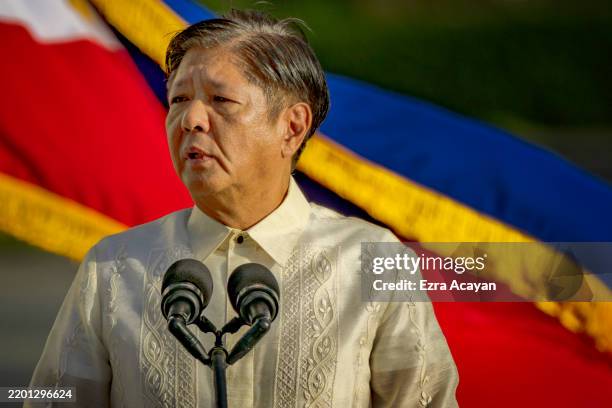
MANILA, PHILIPPINES - FEBRUARY 22: Philippine President Ferdinand Marcos Jr. speaks during the commemoration of the 80th anniversary of the Battle and Liberation of Manila at the Manila American Cemetery on February 22, 2025 in Taguig, Metro Manila, Philippines. The Battle and Liberation of Manila (February 3 – March 3, 1945) was a month-long urban warfare between American-Filipino forces and the Japanese Imperial Army, leading to the city's liberation but also causing massive destruction and the deaths of over 100,000 civilians, mostly due to Japanese atrocities. It was one of the deadliest battles in the Pacific, ultimately ending Japanese occupation in the Philippines and restoring Manila to Allied control. (Photo by Ezra Acayan/Getty Images)
PHILIPPINES DECLARES ENERGY EMERGENCY: FIRST TO SOUND ALARM ON MIDDLE EAST WAR IMPACT
GREATRIBUNETVNEWS–THE Philippines has become the first country to declare a state of national energy emergency in response to energy shortages triggered by the Middle East war
Key Issues:
– _”The declaration of a state of national energy emergency will enable the government, through the DOE and other concerned agencies, to implement responsive and coordinated measures under existing laws to address the risks posed by disruptions in the global energy supply and the domestic economy.”_ – President Ferdinand Marcos Jr.
– Energy Supply Risks : The Philippines relies heavily on imported fuel, with 98% of its crude oil coming from the Middle East, making it vulnerable to global energy market fluctuations.
– _”The current domestic supply of gasoline is expected to last for the next 53.14 days; diesel, 45.82 days; kerosene, 97.93 days; jet fuel, 38.62 days; fuel oil, 61.49 days; and liquified petroleum gas, 23.51 days.”_
– Government Measures : The government is implementing fuel subsidies, free transport, and contingency measures, including a $333 million emergency fund to boost fuel security.
– _”The administration is firm in protecting the Filipino people from external supply shocks and ensuring the continuous, adequate, and reliable availability of fuel across the country.”_ – Energy Department
Measures include enforcing energy conservation measures, introducing fuel subsidies and other initiatives to reduce transport costs, taking action against hoarding, profiteering and manipulation of the supply of petroleum products
About the Author