SOUTH AFRICANS STORM NIGERIAN EMBASSY OVER ‘IGBO KING’ CORONATION
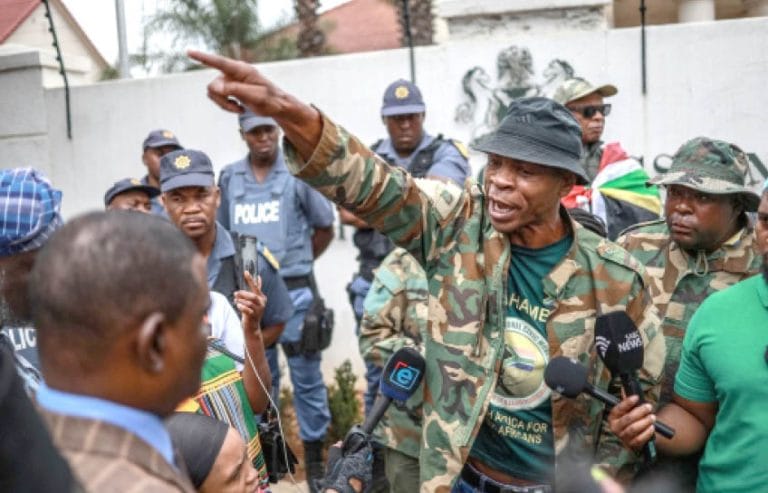
Protesters in South Africa have taken their outrage to the Nigerian High Commission in Pretoria, demanding answers over the coronation of an Igbo traditional leader, Solomon Ogbonna Eziko, as “Igwe Ndigbo” in KuGompo, Eastern Cape. The demonstration turned violent in KuGompo City, with protesters torching vehicles and buildings allegedly owned by foreign nationals .
Key Demands:
– _”We want the Nigerian government to come out strongly against it and for our government to make an unambiguous statement affirming its recognition of existing traditional leaders and rejecting any Igbo kingship in the Eastern Cape or South Africa.”_ – ActionSA
– Deportation of Nigerians involved: Protesters call for immediate deportation of those linked to the coronation
– Respect for South African sovereignty: Demonstrators condemn perceived disregard for local traditions and laws
The Nigerian High Commission has distanced itself from the coronation, stating it was a cultural gathering and not an attempt to establish a parallel authority
Speaking on behalf of the Acting High Commissioner, Ambassador Temitope Ajayi, an officer of the Commission, said, “On behalf of the Federal Republic of Nigeria, I want to apologise for the event that happened recently. I want to let you know that Nigeria is a responsible country that observes the rules and laws of other countries.
“Nigeria has no interest in destabilising South Africa. It’s unfortunate that these things are happening the way they are happening…but Nigeria is a friend to South Africa.”
He said Nigeria played a role in the independence of South Africa, stressing that Nigeria has always been a friendly country.
“Nigeria does not support irresponsibility. I am on behalf of the Federal Republic of Nigeria and the Nigerian High Commission in South Africa, tendering our unreserved apology to the traditional institutions of South Africa.”
‘Some Nigerians dealing in drugs, human trafficking’
Similarly, Bola Babarinde, a former chairman of the All Progressives Congress (APC) in South Africa, alleged that Nigerians dealing in drugs, human trafficking, and other related criminal activities in the country were the cause of the problem.
“The South Africans have been tolerating us all along, but the attitude of some Nigerians who are into drugs and human trafficking provoked them to react.
“In short, it wasn’t the coronation of the Igbo king that triggered the riot, but how our people are taking them for granted.
“Initially, these people loved us, but the hatred came when we started disrespecting the rules and regulations of the host community,” he said.
Babarinde called on the National Orientation Agency (NOA) to work on the character of Nigerians abroad.
“Not only in South Africa but in Ghana, China and other countries because our character abroad is very bad.
“I want to tell you that Nigeria would not tolerate what our people are doing to the South Africans,” he said.
He claimed that most of the properties destroyed during the protest were taxis owned by the South Africans.
“Taxis were burnt, and Nigerians don’t go into the taxi business because they don’t allow foreigners into that sector,” he said.
‘We don’t know value of destroyed property yet’
Speaking with Daily Trust on the phone on Tuesday, the president of the Nigerian Citizens Association South Africa, NICASA, Frank Onyekwelu, clarified that the title of ‘Igwe Ndigbo’ conferred on Eziko was not to undermine the traditional institutions.
He also stated that the installation was not intended to disrespect the governance structure or undermine the sovereignty and constitutional order of South Africa.
Onyekwelu explained that the institution of Igwe Ndigbo is a cultural and traditional expression of the Igbo people in the diaspora, adding that, “Its purpose is strictly to promote unity, preserve cultural identity, and provide social cohesion within the community.
“It does not possess, nor does it seek to exercise, any political or governmental authority within South Africa.
“We can confirm that there was neither a coronation nor any kingdom established; however, a title installation was observed for the single purpose of fostering peace and unity within the cultural heritage of the Igbo people and preserving Igbo culture in diaspora.”
The NICASA president said his group had issued statements in an effort to clarify the situation and apologise for the unrest that greeted the event.
He, however, expressed regret over the destruction of property that followed the protest against the installation of the Igbo king.
Onyekwelu, who confirmed that the protest had stopped, could not put a figure to the losses recorded by the Nigerian community as a result of the unrest.
“At this point, we can’t give an exact volume of loss recorded by the Nigerian community since the protest was against all foreign nationals, not only Nigerians.
“A lot of cars were burned, and businesses were looted,” he said, adding that no deaths had been recorded at the time of his conversation with this paper.
While disclosing that the Nigerian Mission in South Africa was in discussion with the South African government on how to resolve the issue, he urged Nigerians to continue to be peaceful “and not take the law into their hand”.
Like South Africa, like Ghana
The installation of Eze Chukwudi Ihenetu, as ‘Eze Ndi Igbo Ghana’ (King of the Igbo People in Ghana) triggered widespread protests and public outcry across parts of Ghana in July last year.
The development, which drew criticism from youth groups and cultural advocates, was opposed by protesters who said the presence of a foreign monarch undermines Ghana’s sovereignty and traditional chieftaincy institutions.
Protesters in Accra and parts of the Eastern Region were seen carrying placards with messages such as ‘No Foreign Thrones in Ghana’ and ‘Honour Our Heritage’.
Their concerns were amplified after photos of Eze Ihenetu’s elaborate palace in Accra surfaced online, featuring regal emblems and traditional architecture.
However, critics in Ghana argue that the creation of such thrones by foreigners could set a precedent for parallel leadership structures within the country.
There were also unconfirmed reports that the Igbo leader was planning to establish a 50-acre ‘Igbo kingdom’ in Old Ningo, further fuelling suspicion among some Ghanaians.
Alleged land acquisitions by the Igbo community have added to these concerns, although no official evidence was provided.
Public reactions intensified following the circulation of a video showing Ghanaian broadcaster Captain Smart kneeling before Eze Ihenetu during a public ceremony. The footage, which went viral, sparked heated debate on social media.
In response to the controversy, Ihenetu defended his position, stating that the role is ceremonial and meant solely to unify the Igbo community in Ghana.
“The throne of the Diasporan Igbo in Ghana is meant to protect, defend and project the Igbo people and Nigerians as a whole. We have no political authority or territorial ambitions in Ghana. This is purely cultural,” he said in an interview.
An advisory to Nigerians
Meanwhile, the High Commission of Nigeria in South Africa has issued an advisory, urging Nigerians residing in the country to suspend all socio-cultural activities and maintain a low profile.
In a 10-point circular issued on Monday, titled “Advisory to All Nigerians Living in the Republic of South Africa,” the high commission urged Nigerians to prioritise safety and exercise caution amid what it described as “palpable tension” in the country.
The high commission urged Nigerians to be security-conscious at all times, moderate their movement, and limit interaction with unfamiliar people.
It also advised citizens to maintain a low profile, remain law-abiding, and respect local laws and customs.
As part of precautionary measures, the high commission directed Nigerians to “suspend all socio-cultural activities and avoid making inflammatory statements capable of escalating tensions, particularly on social and mainstream media”.
Citizens were further warned to steer clear of demonstrations or counter-protests and to refrain from unnecessary display of wealth or flamboyance.
The advisory also encouraged Nigerians to promptly report any threat to life or property to local security agencies.
“All nationals should consult the Nigerian High Commission in Pretoria or the Consulate General in Johannesburg for clarification on safety measures where necessary,” the statement added.
SOURCE==Daily Trust==DAILY TRUST EXCEPT THE HEADLINE AND INTRO PLUS A FEW PARAGRAPHS
About the Author