IRAN’S ULTIMATUM: CONTROL OVER HORMUZ COULD MEAN BILLIONS
GREATRIBUNETVNEWS–IRAN has added a game-changing demand to its list of conditions to end the war with the US and Israel: recognition of its sovereignty over the Strait of Hormuz. This strategic waterway is crucial, handling a fifth of the world’s oil and liquefied natural gas (LNG) trade.
Key Issues:
– Revenue Generation: Iran could earn $600-800 million monthly from tolls, rivaling Egypt’s Suez Canal revenue.
– Global Economic Leverage: Control over Hormuz gives Iran significant pressure on global trade and energy markets.
– International Law Concerns: Experts question Iran’s right to impose tolls, citing international maritime law.
– Geopolitical Implications: Iran’s move could set a precedent for other chokepoint nations.
– War Impact: The conflict has disrupted global oil supplies, pushing prices up and threatening economic stability .
Iran’s new demand reflects its growing confidence in using Hormuz as a strategic tool. The international community is watching closely, with the US warning against attempts to establish a toll system .
Shipping through the chokepoint has ground to a near halt amid Iranian attacks, sending global energy markets into turmoil and forcing countries far beyond the Persian Gulf to take emergency measures to secure fuel supplies.
“Iran has been a little taken aback by how successful its (Hormuz) strategy has been – by how cheap and how comparatively easy it is to hold the global economy hostage,” said Dina Esfandiary, Middle East lead at Bloomberg Economics. “One of the lessons learned in the war is that it has discovered this new leverage, and it’s likely to use it again in the future. And I think monetizing it is part of discovering that it has this leverage.”
Washington is acutely aware of that risk. US Secretary of State Marco Rubio warned Friday that one of the immediate challenges following the war would be Tehran’s attempts to establish a tolling system at Hormuz.
“Not only is this illegal, it’s unacceptable, it’s dangerous to the world, and it’s important that the world have a plan to confront it,” Rubio said after a G7 meeting in France. Foreign ministers from the group stressed “the absolute necessity” to restore “safe and toll-free freedom of navigation.”
In a nod to the growing strategic weight of the Strait of Hormuz, Mojtaba Khamenei used his first purported address as Iran’s new supreme leader to say that the leverage of blocking the waterway “must continue to be used.”
In previous rounds of talks with the US, Iran pushed for sanctions relief and recognition of its right to peaceful nuclear technology but not control over the Strait of Hormuz.
Iran is now signaling that this leverage could be formalized. Iranian lawmakers are considering a bill that would require countries using the strait for shipping fuel and goods to pay tolls, while an adviser to the supreme leader has spoken of a “new regime for the Strait of Hormuz” after the war. This new system would allow Tehran to impose maritime restrictions on adversaries and effectively tie access to one of the world’s most critical shipping lanes to its geopolitical disputes.
“Imposing transit fees is a violation of the rules of transit passage,” said James Kraska, a professor of international maritime law at the US Naval War College. There is no legal basis under international law for a coastal state to charge fees in an international strait like Hormuz, he added.
“The Strait of Hormuz is a strait used for international navigation, with overlapping territorial seas of Iran and Oman… Within these waters, Iranian and Omani law applies,” he said. “However, because it is an international strait the right of transit passage applies for all states, which permits unimpeded surface, overflight, and submerged transit.”
The rules are set out in the UN Convention on the Law of the Sea (UNCLOS). While neither Iran nor the United States is a party to the convention, Kraska says many of its core principles still apply because they are widely accepted as customary international law. However, Iran may still seek to use its non-membership to bolster its case, he added.
There is little precedent for a state successfully charging for passage through an international strait. In the 19th century, Denmark imposed transit fees through the Danish Straits, but following protests from multiple states it agreed to the Copenhagen Convention of 1857, abolishing the so-called Sound Dues permanently, he said.
Rivaling the Suez Canal
That hasn’t stopped Iran from exploring what such a system could look like, or how lucrative it might be.
Experts question whether Iran could establish a tolling system that would gain international acceptance, but if it does succeed revenues could rival those generated by Egypt’s Suez Canal, according to CNN calculations.
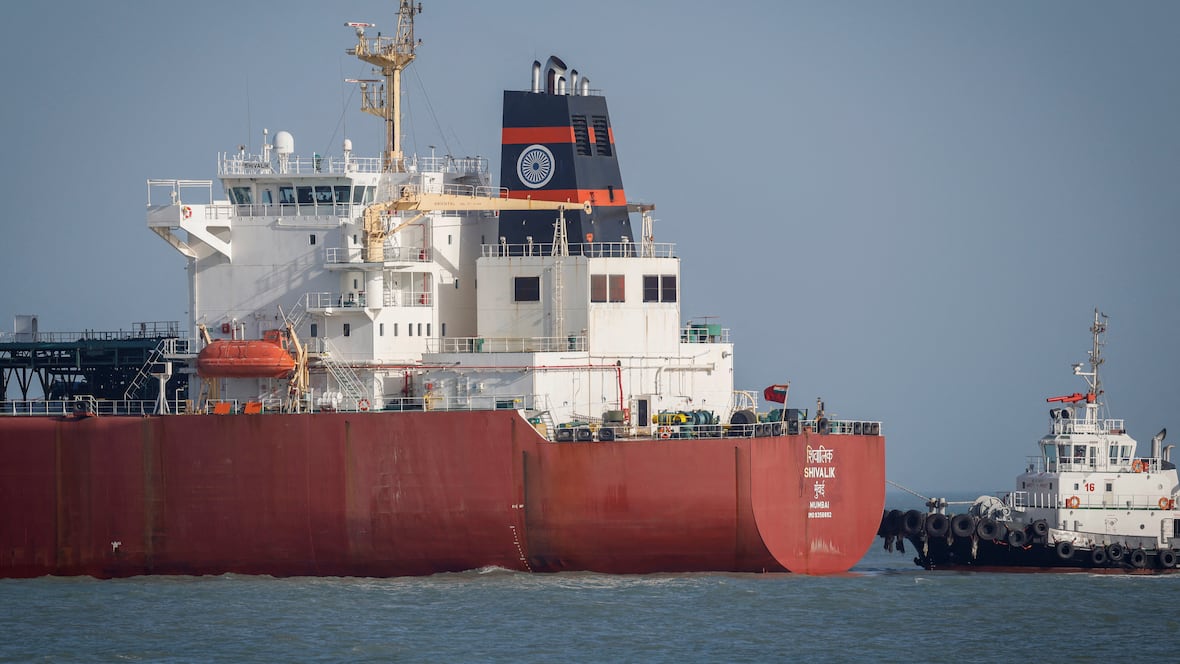
Normally, around 20 million barrels of crude oil and oil products pass through the Strait of Hormuz each day, roughly equivalent to about 10 so-called very large crude carriers (VLCCs). At a reported fee of $2 million per tanker, that would translate to around $20 million a day, or about $600 million a month, from oil alone.
If LNG shipments are included, that figure could rise to more than $800 million a month, equivalent to about 15%-20% of Iran’s monthly oil export revenue in 2024.
For comparison, Egypt earns between $700 and $800 million a month from the Suez Canal, an artificial, government-controlled waterway, in a typical year, although revenues have dropped sharply over the past year due to Red Sea disruptions.
Egypt earns between $700 and $800 million a month from the Suez Canal.
Egypt earns between $700 and $800 million a month from the Suez Canal.
Monetization of Hormuz may also be driven by Iran’s economic pressures. Esfandiary said Tehran sees charging for passage as a way to “make up for some of its economic shortfalls” under sanctions, describing it as a relatively “easy” and “low-cost” mechanism to compensate for restricted access to global markets. Iran is among the world’s most heavily sanctioned countries, second only to Russia.
Iran has repeatedly said the Strait of Hormuz remains open – but not unconditionally. Officials say “non-hostile” vessels may transit, provided they coordinate with Iranian authorities. The foreign ministry conveyed that position in a letter to the UN Security Council and the International Maritime Organization, according to Reuters.
At the same time, Tehran appears to be testing what a controlled system of passage could look like in practice. Ship-tracking data shows some tankers using a route closer to Iran’s coast, with reports that certain operators may have paid for safe passage.
US furiously seeks to avert potential monthslong closure of Strait of Hormuz
No country, importer or ship operator has publicly acknowledged paying a fee, and details of any arrangements remain unclear. But shipping intelligence firm Lloyd’s List reported Monday that more than 20 vessels have used what it described as a new corridor through the strait, with at least two ships understood by Lloyd’s to have paid to do so – one of them reportedly around $2 million.
Iran’s Islamic Revolutionary Guard Corps has also established a registration system for approved vessels, while some governments are engaging directly with Tehran to secure transit for their tankers, Lloyd’s List reported.
“This is happening. And I suspect it’s going to happen slightly more frequently if we don’t see some progress in terms of the negotiations,” Richard Meade, editor in chief of Lloyd’s List, told CNN. “But as we speak right now, the shipping industry is effectively in paralysis.”
SOURCE ==CNN==EXCEPT THE HEADLINE AND INTRO PLUS A FEW PARAGRAPHS
About the Author