
USS GERALD FORD BATTLES FIRE AT SEA DURING RECORD IRAN WAR DEPLOYMENT
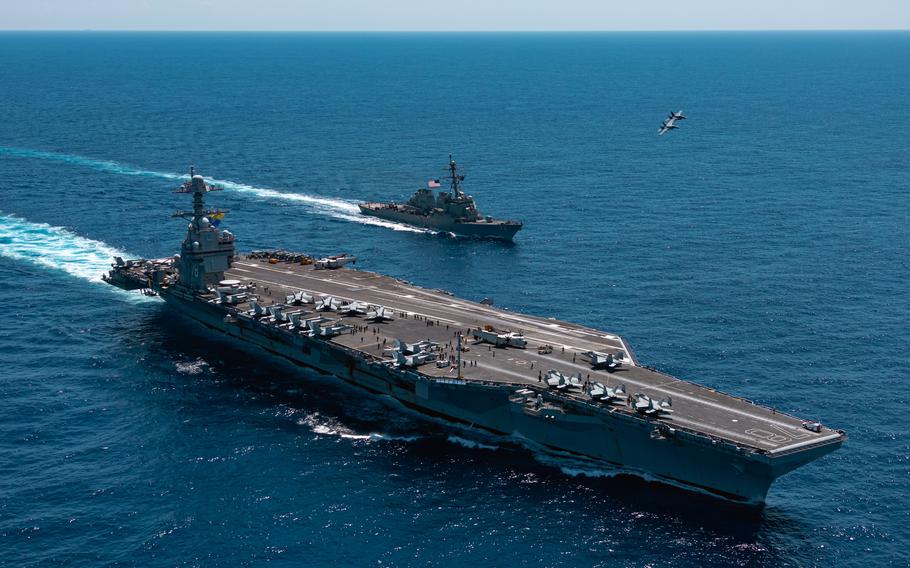
GREATRIBUNETVNEWS– THE USS Gerald R. Ford fought a 30-hour blaze in the eastern Mediterranean while launching strikes against Iran, as the carrier sets a post-Vietnam record for longest deployment at the heart of Trump’s military operations.
Key Issues:
– 30-Hour Fire Fight : _”In mid-March, a fire tore through a compartment of the United States’ largest and most powerful aircraft carrier, the USS Gerald R. Ford… It took the crew 30 hours to put out the fire, clean it up and prevent it from reigniting, and roughly 600 sailors lost access to their bunks due to the damage.”_
– Blaze During Iran War Sorties : _”The ship was floating in the eastern Mediterranean Sea, launching aircraft as part of the weeks-old war with Iran, when the blaze broke out in the laundry department.”_ _”They also couldn’t do laundry, though fortunately no sailors were seriously injured.”_
– Record-Breaking Deployment : _”It was just the latest trial for the crew of the Ford, which is slated, by one count, to break a record this week for the longest deployment for an aircraft carrier since the Vietnam War.”_
– Center of Trump’s Operations : _”The ship has served as the tip of the spear of President Donald Trump’s interventionist foreign policy, from helping capture Venezuelan President Nicolás Maduro in January to launching waves of aircraft in the Iran war.”_
– Global Mission Strain: _”The combination of missions since the ship pulled away from Virginia in June has included pinballing across the Atlantic, initially heading to the Mediterranean and up to Norway as part of its scheduled trip before being pulled to the Caribbean for the Maduro operation. Then it got ordered to rapidly make its way to aid in a potential Middle East war, stopping briefly to get an issue with the ship’s toilets fixed.”_
– Rapid Return to Combat: _”Two days after the fire, the Ford was able to fly sorties again. The ship then headed to Greece for repairs, but was back at sea after an additional stop in Croatia in time to be available for Trump’s threatened day of infrastructure strikes in Iran last week.”_
– Wear on Ship and Crew: _”Carriers on long deployments often face increasing gremlins as components wear out and repairs at sea serve as temporary band aids. Arresting cables that catch landing aircraft begin to fray and saltwater seeps into shipboard systems, among other minor issues that begin to compound.”_
– Symbol of Power and Limits: _”The $13 billion ship is the newest and most technologically advanced of the 11 US nuclear-powered aircraft carriers and has become a symbol of the strength, and limits, of US naval power.”_ _”If we didn’t have the Ford, we would be struggling to maintain an operational presence, but we’d also be struggling to keep our aircraft carriers ahead of our enemies.”_ — Brent Sadler, 26-year Navy veteran and former submarine officer
– Families Under Strain: _”It’s constant uncertainty that we live on a daily basis… Sometimes, I can hardly sleep.”_ — Amini Osias, father of a Ford aviation electrician. After _”The Iranian military’s downing of a US fighter jet this month”_ he said, _”That could have been my daughter if she would have joined the Air Force.”_
The trip has been _”formally extended by the military twice”_ as the Ford’s travails raise _”broader questions about how the strain on Navy assets over the last year positions the military service for a future that could include war with China in the Pacific.”_
The Navy referred questions about the Ford’s role in the Iran and Venezuela operations to US Central and Southern Command, the military commands that, respectively, have overseen those operations. The commands declined to provide any specifics.
CNN also contacted the “ombudsman” for the Ford, which connects the ship’s command with sailors’ family members. The ombudsman referred questions to the Ford’s public affairs office.
“As with any deployed warship, we conduct routine and emerging maintenance as required; there are no current maintenance requirements that would preclude the continued operational success of the world’s largest aircraft carrier,” said Lt. Commander Ada Willis, a public affairs officer for the Carrier Strike Group 12 that includes the Ford.
In response to questions from CNN about challenges to morale on the Ford, Willis said that, “Morale fluctuates over the course of any deployment; the grit and resiliency of our Sailors are some of our most valued traits as a crew, and we work every day to support each other through this historic deployment.”
The USS Gerald R. Ford, the world’s largest aircraft carrier, departs from Souda Naval Base near Chania on the island of Crete, Greece, on February 26.
The USS Gerald R. Ford, the world’s largest aircraft carrier, departs from Souda Naval Base near Chania on the island of Crete, Greece, on February 26. Giannis Angelakis/AP
‘It stresses the families’
Current and former military officials say the Ford has been indispensable in the Iran and Venezuela operations.
The ship’s electronic catapult system allows it to launch anything from small drones to big aircraft, giving commanders an array of firepower options, Sadler said. The other 10 US aircraft carriers don’t have that capability.
But the US military’s reliance on the Ford, and its sailors, has also been on full display during the Iran war.
While parked near Venezuela, aircrew from the Ford flew a relatively low number of sorties — most of which took place during a short window once Trump approved the operation to capture Maduro. After moving to the Middle East, those pilots flew more missions as US forces moved from using primarily stand-off weapons to bombs dropped by aircraft flying in Iranian airspace.
Even before Trump announced a ceasefire with Iran on Tuesday, the Ford’s leadership informed sailors that it expected to return to the US in May, according to a source with the matter. Although the end is in sight for the crew, extended deployments tend to leave lingering effects.
Sailors prepare cargo for transport on the flight deck, during a vertical replenishment while underway in the Caribbean Sea, on December 14, 2025.
Sailors prepare cargo for transport on the flight deck, during a vertical replenishment while underway in the Caribbean Sea, on December 14, 2025. Petty Officer 2nd Class Alyssa Sperle/USS Gerald R. Ford/US Navy
A sailor signals the launch of an F/A-18E Super Hornet aircraft on the flight deck of USS Gerald R. Ford, during Operation Epic Fury, on March 16.
A sailor signals the launch of an F/A-18E Super Hornet aircraft on the flight deck of USS Gerald R. Ford, during Operation Epic Fury, on March 16. US Navy/US Central Command Public Affairs
“Navy analysis shows that once a ship crosses six months on a given deployment,” issues with retention and morale “accelerate,” according to retired Adm. James Stavridis, former supreme allied commander at NATO. He said he would “expect challenges for the crew” of the Ford, given the length of the deployment.
The record deployment can challenge sailors, but the Ford does have a unique crew member onboard whose mission is to help relieve stress.
A female Labrador retriever named Sage has served as a therapy dog on the Ford since 2023, initially as part of a trial of the concept for the Navy. Sage, who holds the rank of captain, is “trained to alert to anxiety, reduce stress, and interrupt detrimental behaviors,” said Tara Fisher, a spokesperson for Mutts with a Mission, a nonprofit that connects specially trained dogs like Sage with military and law enforcement personnel.
Aboard the Ford, Sage is “enhancing the resiliency of her shipmates, lowering stress, breaking down barriers and reducing the stigma around mental health,” Fisher said. Sage has “extensive training” in navigating the vast ship and has her own medical kit and safety equipment, according to Fisher. One of Sage’s goals is to be “a catalyst for conversations, encouraging sailors and Marines to seek professional support,” Fisher said. Those skills are in high demand as the Ford remains at sea and recovers from an intense few months of combat.
Sailors pet Sage, a dog assigned to the USS Gerald R. Ford through Mutts with a Mission, on August 4, 2025.
Sailors pet Sage, a dog assigned to the USS Gerald R. Ford through Mutts with a Mission, on August 4, 2025. Petty Officer 2nd Class Alexander Casco/USS Gerald R. Ford/US Navy
The Navy as a whole is facing issues with sailor burnout, according to multiple sources familiar with internal Navy discussions about the issue. Navy aviation personnel, from pilots to maintainers, are leaving the service at a high rate, according to those sources.
Defense Secretary Pete Hegseth has ordered a review of attrition rates among Navy Strike Fighter Squadrons, according to a March memo from Hegseth obtained by CNN. To retain top talent, the Navy is also offering flight officers and naval aviators tens of thousands of dollars annually in bonuses.
“We’re at a point right now where retention’s not great,” said retired Vice Adm. Andrew “Woody” Lewis, former commander of the Navy’s Second Fleet, citing the evergreen challenge of uncertainty over deployments for Navy personnel and the length of time it takes for Navy pilots to get certified to fly. “It eats into your mentality when there’s a lot of uncertainty, things take longer than they should. You get a lot of administrative burden coming down on you,” Lewis said. “It stresses the families, stresses the individuals.”
Lewis and other former senior Navy officials said the Ford’s crew would relish the challenge of being at sea that long and the Ford’s command would be closely attuned to burnout issues and stresses on the families.
“It’s a curse and a blessing at the same time, being on an aircraft carrier,” said Lewis, who did 11 aircraft carrier deployments of six months or more. The blessing: Aircraft carriers are used for a lot of “very strategically important missions,” Lewis said. “And it’s a curse at the same time because you got to go, you get extended, you get these long periods of you don’t know what the hell is going on.
SOURCE ==CNN==EXCEPT THE HEADLINE AND INTRO PLUS A FEW PARAGRAPHS
About the Author