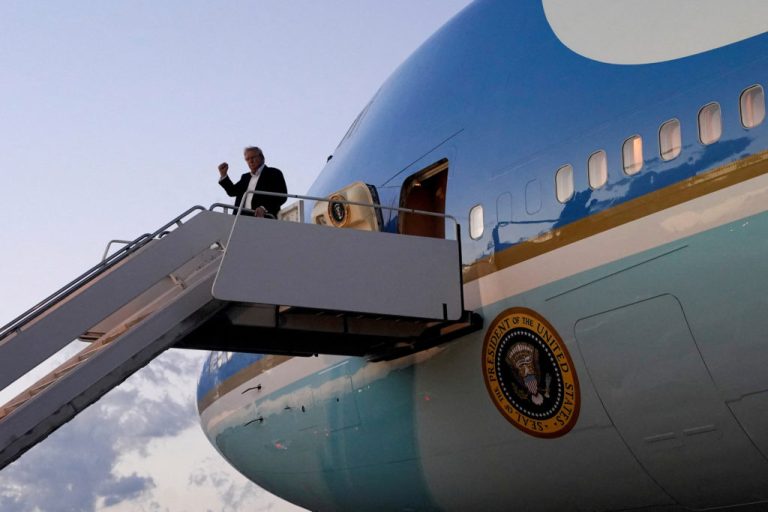
FILE PHOTO: U.S. President Donald Trump pumps a fist as he disembarks Air Force One at Palm Beach International Airport, West Palm Beach, Florida, U.S., April 11, 2025. REUTERS/Nathan Howard/File Photo

TOO BIG TO LAND: TURKEY BLOWS $120M AND 8 MONTHS TO FIT QATAR’S MONSTER GIFT TO TRUMP
GREATRIBUNETVNEWS–THE palatial Boeing 747 Qatar gave the US is so colossal that Turkey was forced to demolish and rebuild a whole military airport just to let it touch down for the NATO summit.
The Key Issues, In Full Quotations:
1. The $120 Million Problem
“The palatial 747 donated by Qatar to the United States is so big and heavy that Turkey had to spend more than $120 million and eight months rebuilding an entire military airport runway just so the new Air Force One could land for the NATO summit”
2. The Monster Jet By The Numbers
“The $400 million Boeing 747-8 donated by Qatar to the United States is not simply another presidential aircraft. At more than 76 meters (250 feet) long and weighing up to 442 tonnes at maximum takeoff, it is the largest airliner Boeing has ever built. Its sheer size is so extraordinary that before it could make one of its highest-profile appearances as the future Air Force One, Turkey had to modernize an entire airport so it could accommodate the giant jet.”
3. The Airport Turkey Had To Resurrect
“That transformation took place ahead of the NATO summit in Ankara, where Turkey reopened the former military Etimesgut Airport after an eight-month reconstruction project. Operating under the code ‘ANK,’ the airport has been repurposed to handle VIP, diplomatic and state flights while easing congestion at Ankara’s main Esenboğa Airport, as reported by TurkiyeToday. Among the dozens of government aircraft expected for the summit, none demanded more from the airport than the Boeing 747-8 being converted into America’s next Air Force One.”
4. Not Just Longer, Far Wider – The Real Engineering Feat
“The reconstruction was far more extensive than extending the runway. While its length increased from 2,450 meters to 3,000 meters, the more significant engineering challenge was widening it from 42 meters to 60 meters. That single change upgraded the airport to ICAO Category F standards, the highest aerodrome classification used by commercial aircraft and one shared only by the Boeing 747-8 and the Airbus A380.”
5. Why Normal Airports Can’t Handle It
“The reason lies in the aircraft’s enormous 68.4-meter wingspan. Most of the world’s major airports are designed to ICAO Category E standards, but the 747-8 falls into the larger Category F because of its size. Before the reconstruction, Etimesgut’s runway was narrower than even Category E requirements, meaning the aircraft could not normally operate there under standard airport specifications. Widening the runway to 60 meters solved that problem, allowing the jumbo jet to use the airport without requiring exceptional operational measures.”
6. Why Ankara’s Altitude Made It Even Harder
“Runway length presented a different challenge. The Boeing 747-8 is not only the world’s longest airliner but also Boeing’s heaviest commercial aircraft, with a maximum take-off weight of around 442 tonnes (about 975,000 pounds). Ankara sits roughly 808 meters (2,650 feet) above sea level, and the summer heat further increases density altitude, reducing engine performance and lift. Under those conditions, the previous 2,450-meter runway would have offered little margin for a heavily loaded transatlantic departure. Extending it to 3,000 meters ensured the airport could comfortably accommodate the aircraft’s operational requirements.”
_America’s new $400M Air Force One is so huge, no runway could handle it – Ankara had to build one_
One plane. One runway. $120 million.
*7. The World’s Most-Watched Landing*
> “Extending the runway to take a jet this size cost in the region of $120 million, and the investment proved worthwhile when the future Air Force One became the largest visiting aircraft at the NATO summit. While most foreign delegations arrived aboard Airbus A330s, A340s, A350s or smaller government aircraft, the Boeing 747-8 was the summit’s only visiting Category F aircraft. On the day of its arrival, Air Force One also became the most-tracked aircraft on flight-tracking platforms, turning Ankara’s newly rebuilt diplomatic airport into one of the world’s most closely watched aviation stages.”
The VC-25A is based on the Boeing 747-200B
Bigger than the current Air Force One
The aircraft’s extraordinary dimensions also explain why it is considerably larger than the aging VC-25A fleet it will eventually replace. The current Air Force One jets are based on the Boeing 747-200B introduced in the late 1980s. The newer 747-8 stretches just over 76 meters in length, making it nearly 6 meters longer than the VC-25A, while its wingspan extends about 4 meters farther. Those seemingly modest increases are significant enough to move the aircraft into an entirely different airport category, forcing airports to meet stricter runway-width requirements.
This is not the first time the aircraft’s size has shaped airport infrastructure. Before being donated to the United States, the Emir of Qatar regularly traveled aboard the Boeing 747-8 as his personal aircraft. During a vacation to the Italian island of Sardinia, local aviation authorities used its arrival as the first real-world operational validation of a newly upgraded runway. Once the giant jet completed the landing successfully, the airport was cleared for ultra-long-haul operations, illustrating how the aircraft’s extraordinary dimensions have repeatedly served as the benchmark for major airport upgrades.
Turkey’s reconstruction of Etimesgut followed the same pattern. Beyond the wider and longer runway, the project included upgraded taxiways, a 160,000-square-meter apron capable of accommodating 44 aircraft, new navigation and lighting systems, and expanded protocol facilities. When the future Air Force One rolled onto the tarmac, it was far more than another diplomatic arrival. It became the first globally scrutinized demonstration that Turkey’s new diplomatic gateway could successfully handle one of the largest and most demanding government aircraft ever built.
The books lining the shelves inside America’s new interim Air Force One have sparked an outsized debate. After photographs from inside the aircraft surfaced online, eagle-eyed social media users noticed several leather-bound volumes carrying generic titles such as Library, Arts, Jewelry, and Antiques. Instead of recognizable titles or authors, many of the matching beige and brown spines appeared to repeat the same generic labels, prompting widespread speculation that the shelves had been filled with decorative rather than functional books.
Many quickly dismissed them as fake books, turning the shelves into an unexpected talking point, per a report by People. Yet the criticism overlooks an important fact. If those books are indeed decorative rather than traditional hardcovers, they are doing exactly what they were designed to do. Far from being an oddity, lightweight decorative books are a well-established feature of ultra-luxury aircraft interiors, where every design decision is measured against weight, safety and long-term operating costs.
The bookshelf itself also wasn’t created for its new presidential role. It was part of the Boeing 747-8’s original royal interior commissioned for the Emir of Qatar years before the aircraft was donated to the United States and transformed in record time into the Bridge Air Force One while Boeing continues work on the next-generation presidential fleet.
The “library” that launched a thousand jokes. The bookshelves either side of the screen were part of the jet’s original royal fit-out, a standard flourish on head-of-state aircraft where decorative volumes save weight, pass safety certification and never warp in the cabin air.
Why fake books make perfect sense aboard an aircraft
That residential atmosphere was intentional from the beginning. The aircraft’s original interior was designed for Qatar’s royal family by renowned luxury designers who drew inspiration from superyachts and high-end apartments. The upper-deck lounge included built-in bookshelves, a sofa and a large television, making the library wall an original architectural feature rather than a recent addition. While it cannot be confirmed from publicly available information whether the specific books visible today are the same ones installed during the original completion or were replaced during the American refit, the bookshelf itself has been part of the aircraft for well over a decade.
The upper deck of the jet also has a library
There are practical reasons why decorative books have become common in VIP aviation. Weight is the biggest. Real hardcover books are surprisingly heavy, with just one linear foot of books typically weighing between 20 and 35 pounds. A single four-foot shelf packed with books can weigh as much as 140 pounds, and a full feature wall spanning several shelves can approach 480 pounds, or roughly 218 kilograms. Lightweight decorative books can recreate the same elegant appearance while weighing only a fraction as much.
Those fake books predate the president. The library feature was installed when the Boeing 747-8 belonged to the Qatari royal family, over a decade before it became Air Force One.
That reduction matters because every kilogram carried by an aircraft consumes fuel throughout its operational life. Aviation industry estimates suggest removing just 1kg can save thousands of dollars in fuel over an aircraft’s lifetime. Multiply that by hundreds of kilograms, and replacing real books with lightweight display pieces becomes an easy engineering decision.
Decbooks UK is one of the largest vendors of faux books
Luxury design meets aviation engineering
Safety is another important consideration. Loose hardback books must be secured to meet strict aviation certification standards and could become dangerous projectiles in severe turbulence if not properly restrained. Permanently fixed decorative books are far easier to certify and remain securely in place throughout the aircraft’s service. Maintenance also favors decorative displays. Aircraft cabins experience repeated pressure changes, temperature fluctuations and humidity cycles that can warp paper, discolor bindings and damage genuine books over time. Decorative books require virtually no upkeep while preserving the warm, residential feel designers are trying to create.
The bookshelf only came under scrutiny after White House staffers offered a rare look inside the new Air Force One especially after a photograph was posted by White House Press Secretary Karoline Leavitt. The images revealed far more than the now-famous shelves, showcasing massage seats, a boardroom, gold accents, bowls of presidential M&Ms and Apple TV displays, all surrounded by richly finished wood cabinetry. The aircraft later flew over Mount Rushmore during America’s 250th Independence Day celebrations, giving millions another glimpse of the highly anticipated jet.
This philosophy extends well beyond bookshelves. Modern VIP aircraft routinely use lightweight composite materials, imitation wood veneers, and engineered finishes that faithfully reproduce the appearance of heavier luxury materials while reducing overall weight. Decorative books simply follow the same design logic. In that context, the viral bookshelf says less about appearances than it does about the unique challenges of building one of the world’s most sophisticated aircraft interiors. What looked to many observers like an unnecessary design flourish is, in reality, a practical solution borrowed from the world of royal aircraft, private wide-body jets and superyachts. Sometimes the smartest engineering decision is the one that looks almost indistinguishable from the real thing.
The books lining the shelves inside America’s new interim Air Force One have sparked an outsized debate. After photographs from inside the aircraft surfaced online, eagle-eyed social media users noticed several leather-bound volumes carrying generic titles such as Library, Arts, Jewelry, and Antiques. Instead of recognizable titles or authors, many of the matching beige and brown spines appeared to repeat the same generic labels, prompting widespread speculation that the shelves had been filled with decorative rather than functional books.
Many quickly dismissed them as fake books, turning the shelves into an unexpected talking point, per a report by People. Yet the criticism overlooks an important fact. If those books are indeed decorative rather than traditional hardcovers, they are doing exactly what they were designed to do. Far from being an oddity, lightweight decorative books are a well-established feature of ultra-luxury aircraft interiors, where every design decision is measured against weight, safety and long-term operating costs.
The bookshelf itself also wasn’t created for its new presidential role. It was part of the Boeing 747-8’s original royal interior commissioned for the Emir of Qatar years before the aircraft was donated to the United States and transformed in record time into the Bridge Air Force One while Boeing continues work on the next-generation presidential fleet.
The “library” that launched a thousand jokes. The bookshelves either side of the screen were part of the jet’s original royal fit-out, a standard flourish on head-of-state aircraft where decorative volumes save weight, pass safety certification and never warp in the cabin air.
Why fake books make perfect sense aboard an aircraft
That residential atmosphere was intentional from the beginning. The aircraft’s original interior was designed for Qatar’s royal family by renowned luxury designers who drew inspiration from superyachts and high-end apartments. The upper-deck lounge included built-in bookshelves, a sofa and a large television, making the library wall an original architectural feature rather than a recent addition. While it cannot be confirmed from publicly available information whether the specific books visible today are the same ones installed during the original completion or were replaced during the American refit, the bookshelf itself has been part of the aircraft for well over a decade.
The upper deck of the jet also has a library
There are practical reasons why decorative books have become common in VIP aviation. Weight is the biggest. Real hardcover books are surprisingly heavy, with just one linear foot of books typically weighing between 20 and 35 pounds. A single four-foot shelf packed with books can weigh as much as 140 pounds, and a full feature wall spanning several shelves can approach 480 pounds, or roughly 218 kilograms. Lightweight decorative books can recreate the same elegant appearance while weighing only a fraction as much.
Those fake books predate the president. The library feature was installed when the Boeing 747-8 belonged to the Qatari royal family, over a decade before it became Air Force One.
That reduction matters because every kilogram carried by an aircraft consumes fuel throughout its operational life. Aviation industry estimates suggest removing just 1kg can save thousands of dollars in fuel over an aircraft’s lifetime. Multiply that by hundreds of kilograms, and replacing real books with lightweight display pieces becomes an easy engineering decision.
Decbooks UK is one of the largest vendors of faux books
Luxury design meets aviation engineering
Safety is another important consideration. Loose hardback books must be secured to meet strict aviation certification standards and could become dangerous projectiles in severe turbulence if not properly restrained. Permanently fixed decorative books are far easier to certify and remain securely in place throughout the aircraft’s service. Maintenance also favors decorative displays. Aircraft cabins experience repeated pressure changes, temperature fluctuations and humidity cycles that can warp paper, discolor bindings and damage genuine books over time. Decorative books require virtually no upkeep while preserving the warm, residential feel designers are trying to create.
The bookshelf only came under scrutiny after White House staffers offered a rare look inside the new Air Force One especially after a photograph was posted by White House Press Secretary Karoline Leavitt. The images revealed far more than the now-famous shelves, showcasing massage seats, a boardroom, gold accents, bowls of presidential M&Ms and Apple TV displays, all surrounded by richly finished wood cabinetry. The aircraft later flew over Mount Rushmore during America’s 250th Independence Day celebrations, giving millions another glimpse of the highly anticipated jet.
This philosophy extends well beyond bookshelves. Modern VIP aircraft routinely use lightweight composite materials, imitation wood veneers, and engineered finishes that faithfully reproduce the appearance of heavier luxury materials while reducing overall weight. Decorative books simply follow the same design logic. In that context, the viral bookshelf says less about appearances than it does about the unique challenges of building one of the world’s most sophisticated aircraft interiors. What looked to many observers like an unnecessary design flourish is, in reality, a practical solution borrowed from the world of royal aircraft, private wide-body jets and superyachts. Sometimes the smartest engineering decision is the one that looks almost indistinguishable from the real thing.
The newest aircraft to carry the call sign Air Force One is unlike any of its predecessors. Housed within the airframe of a VVIP Boeing 747-8 originally built for Qatar’s royal family, the jet combines the scale of a widebody airliner with the bespoke craftsmanship of a royal residence. While it is expected to serve only as an interim presidential aircraft before Boeing delivers the long-delayed VC-25B fleet, its lavish interior has already made it one of the most talked-about aircraft in the world.
The aircraft was presented publicly during the President’s tour at Joint Base Andrews last month, marking the first official look at the extensively refurbished jet. Days later, the President took his first flight aboard the aircraft on a trip to North Dakota, offering the public its first glimpse inside. That unveiling was unusually controlled, as reported by the New York
Members of the traveling press were reportedly allowed to photograph only their seat cards and meals, while nearly all of the interior images that quickly circulated came from photographs shared by senior White House officials. The aircraft is expected to make its first major public appearance during the 250th Independence Day celebrations at Mount Rushmore before continuing presidential duties as the administration awaits the arrival of the next-generation VC-25B aircraft.
A presidential aircraft with the feel of a bespoke private jet
Outside, the 747-8 has traded its former Qatari royal livery for a new blue, white, red and gold paint scheme created for its presidential role. The aircraft itself is considerably larger than the VC-25A jets it temporarily supplements, stretching roughly 20 feet longer with a wingspan around 30 feet wider. That additional space is immediately apparent once inside.
The publicly revealed areas are finished in warm cream, beige and tan tones, with polished wood surfaces, cream leather seating and gold-toned light fixtures replacing the more utilitarian appearance typically associated with military aircraft. Throughout the cabin, presidential seals appear on seat belts, cushions and decorative details, while framed artwork depicting American landmarks gives the interior the atmosphere of a formal executive residence rather than a conventional government transport. One of the standout spaces is the executive conference room. Centered around a large circular polished wood table surrounded by cream leather captain’s chairs, the room resembles a modern corporate boardroom. Place settings, leather writing pads and “Welcome Aboard Air Force One” cards complete a space designed as much for diplomacy and discussion as for travel.
From the conference room to the press cabin
The most thoroughly documented section is the press cabin, where reporters experienced a noticeable upgrade over the seating found aboard the outgoing aircraft. Large tan leather seats recline fully, incorporate built-in massage functions and offer individual charging points alongside seatback entertainment screens with access to cable television and Apple TV. A curtain separates the press section from staff and Secret Service work areas, providing greater privacy while also keeping operational areas out of public view.
Even the smallest details reflect the aircraft’s recent transformation. Meals are served on gold-and-white china carrying the presidential seal, accompanied by the familiar presidential M&Ms as well as ribbon-tied boxes of chocolates prepared for passengers. During the inaugural presidential flight, headphones remained sealed in their original packaging, blankets were still wrapped in protective plastic and commemorative seat cards marked the occasion, underscoring just how recently the aircraft entered service.
A brief chapter before the next generation arrives
Although only selected portions of the aircraft have been shown publicly, the Boeing 747-8 is widely understood to retain much of the spacious architecture developed during its years as a royal VIP aircraft. Before entering US government service, the jet was configured for fewer than 100 passengers and reportedly featured expansive lounge areas, private office space, and multiple gathering rooms spread across two decks. The White House has not revealed those sections following the conversion, but the generous proportions of the original layout remain evident in the areas that have been made public.
Its presidential career is expected to be relatively short. The converted 747-8 will bridge the gap until Boeing’s purpose-built VC-25B aircraft finally enter service, bringing an end to years of delays surrounding the replacement program. Once those aircraft assume the Air Force One mission, the interim jet is expected to be displayed at the proposed Presidential Library, preserving an aircraft whose journey from a royal gift to a presidential transport has few parallels in modern aviation.
While the current Air Force One has served the US leader since 1990, the luxury 747 donated by the Qatari royal family will be the shortest-lived Air Force One in history, retiring a mere 934 days after making its first flight today to grace a swanky presidential library in Miami
The Boeing 747 gifted by Qatar to the United States is poised to make aviation history, though perhaps not in the way most presidential aircraft do. After undergoing a rapid transformation into an interim Air Force One known as the VC-25B Bridge, the jet is expected to enter service today, carrying the president to North Dakota for the dedication of the Theodore Roosevelt Presidential Library in Medora, one of several events marking America’s 250th Independence Day. Yet if current plans remain unchanged, the aircraft’s time as a presidential transport will be remarkably brief.
By comparison, the current Air Force One has been serving since 1990. The White House has confirmed that the 747 would be handed over to Trump’s presidential library foundation by the end of his term, according to a report by NBC News. By the time the current presidential term ends on January 20, 2029, the jet will have spent just 934 days in service. That would make it the shortest-lived dedicated Air Force One generation in modern history, a striking distinction for an aircraft that has already attracted enormous attention for its unusual journey from luxury jet to presidential transport.
A bridge Air Force One for a delayed replacement program
The VVIP Boeing 747’s rapid transformation is closely tied to delays surrounding the long-running VC-25B program. Boeing has been working for years on two brand-new Air Force One aircraft intended to replace the aging VC-25A fleet that entered service is 1990 during the administration of President George H.W. Bush. Those iconic Boeing 747s remain among the most recognizable aircraft in the world, but repeated delays have pushed the arrival of their successors further into the future.
The 747 was one of the luxury jumbo jets used by the Qatari royal family
To bridge that gap, the former Qatari Boeing 747 was selected for a fast-track conversion program. Rather than focusing on luxury upgrades, the effort concentrated on safety, security, mission execution, and secure communications, while keeping its royal interior mostly intact. L3Harris carried out the missionization work while Boeing provided engineering support for structural modifications.
The aircraft has now completed modification and flight-testing phases and emerged wearing a new presidential-style livery featuring red, white, blue, and gold accents. The result is an interim presidential transport that is expected to make a highly symbolic appearance during a visit to Mount Rushmore on July 3, part of the celebrations leading into America’s 250th Independence Day. Plans for the event reportedly include a large fireworks display over the iconic monument, giving the new aircraft a memorable early mission as it begins its unusually short service career.
A presidential aircraft with an unusually short future
What makes the aircraft unique is not merely how quickly it entered service, but how quickly it may leave it. Plans associated with the future presidential center in Miami envision the jet becoming a major attraction after its government service concludes. Once retired from presidential duty, the aircraft would be transferred to the Donald J. Trump Presidential Library Foundation as part of a broader museum and visitor complex planned for a waterfront site near Miami’s Freedom Tower.
That transition would not be as simple as parking an airplane beside a building. A presidential aircraft contains secure communications equipment, specialized mission systems, and other sensitive technology that cannot simply be handed over to a museum. Before any transfer occurs, the aircraft would almost certainly undergo extensive decommissioning.
Secure systems would need to be removed, downgraded, or otherwise sanitized, effectively transforming the aircraft from an operational government asset into a public exhibit. In practical terms, the jet would live two very different lives. First as a working presidential transport and later as a symbolic representation of that role.
From flying command post to museum centerpiece
Renderings of the proposed Miami complex suggest the aircraft could become one of its defining attractions. Plans released for the project depict a large waterfront development featuring a museum, event spaces, replica presidential rooms, and potentially even a hotel component. A Boeing 747 is prominently incorporated into the designs, echoing the way retired presidential aircraft have been displayed at other presidential libraries.
There is precedent for such a move. The retired Boeing 707 known as SAM 27000 eventually found a permanent home at the Ronald Reagan Presidential Library, where it remains one of the institution’s most popular exhibits. The difference is that those aircraft served for decades before retirement. By contrast, the Qatar-donated VC-25B Bridge could spend only about two and a half years carrying out presidential missions.
That timeline gives the aircraft a unique place in presidential aviation history. While the VC-25As have served for more than three decades and earlier presidential aircraft often remained in service for many years, the bridge aircraft appears destined for a far shorter operational career. Its legacy may ultimately be defined not by the missions it flew, but by the unusual path that took it from luxury jet to Air Force One and then, just 932 days later, into retirement as a museum centerpiece.
Follow Luxurylaunches on Google News
Follow Luxurylaunches on Google News
Tags from the story
Air-Force-One, Boeing
About Luxurylaunches
Luxurylaunches.com is an award winning premium lifestyle website. It features the latest and the best from the world of extravagance and opulence.
SOURCE ==CNN==EXCEPT THE HEADLINE AND INTRO PLUS A FEW PARAGRAPHS
About the Author