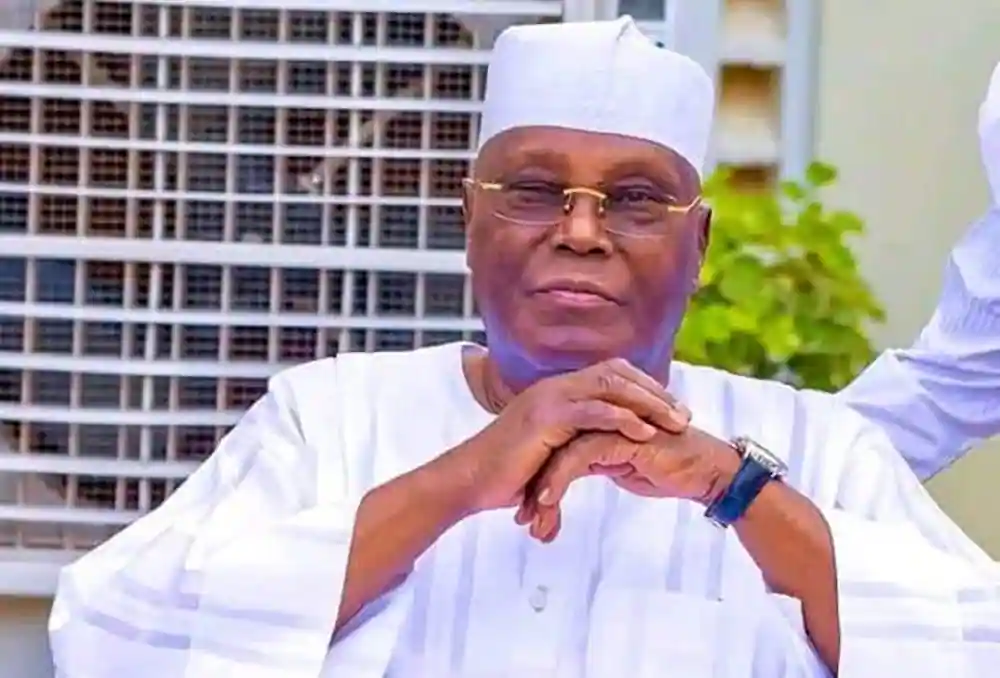
“GREATEST ECONOMIC CRIME”: TGF SLAMS “BORIS YELTSIN” ATIKU OVER PRIVATIZATION WRECKAGE
GREATRIBUNETVNEWS–TGI Group says ex-VP’s NCP tenure “liquidated and looted” national assets, calls his defense of BPE sell-offs an insult to workers still waiting for steel, power, telecoms.
Key Issues:
- – Core Allegation: _”THE AUDACITY OF A FAILED ARCHITECT – ATIKU ABUBAKAR, NIGERIA’S ‘BORIS YELTZIN’ MUST ACCOUNT FOR THE GREATEST ECONOMIC CRIME IN NIGERIA’S POST-INDEPENDENCE HISTORY”_
– TGF Counterpunch: _”TGF responds to former Vice President Atiku Abubakar’s reckless and uneducated tirade against PBAT.”_
– Denouncing Attacks on Tinubu: _”The Transformative Governance Forum (TGF) has observed with a mixture of utter bewilderment and righteous indignation the constant reckless, intellectually dishonest, and patently uneducated tirades and asinine comments unleashed by the hijackers against the person and office of His Excellency, President Bola Ahmed Tinubu, GCFR.”_
– lAtiku’s ‘Uneducated’ Jibe Backfires: _”When former Vice President Atiku Abubakar rose this week to defend his stewardship of Nigeria’s privatisation programme — dismissing criticism from President Bola Tinubu as the utterances of an ‘uneducated’ man — he committed an offence far greater than the irony contained in that statement. He insulted the memory of every Nigerian worker who lost their livelihood. He mocked the communities hollowed out by the deliberate destruction of their industrial base. He spat in the face of a nation that has spent over two decades waiting for steel that never came, for power that never flowed, for telecommunications that were sold into the hands of cronies and left to rot.”_
– NCP Legacy Branded “Catastrophic”: _”It is a profound irony—indeed, a tragic commentary on the state of our political discourse—that a man whose tenure as Chairman of the National Council on Privatisation (NCP) stands as the single most catastrophic chapter in Nigeria’s economic history would have the unmitigated audacity to lecture a visionary reformer like PBAT on the mechanics of public enterprise reform. The former Vice President’s assertion that President Tinubu is ‘not properly educated’ on the subject of privatization is not merely an insult; it is a monumental confession of his own profound ignorance of the ruins he left behind.”_
– “Carcasses” of National Patrimony: _”If Mr. Abubakar were indeed properly educated—or even minimally acquainted with the facts of his own disastrous tenure—he would not be parading the carcasses of Nigeria’s industrial patrimony as trophies of a job well done.”_
– Call to Audit BPE Sell-Offs: _”THE GRAVEYARD OF ATIKU’S PRIVATIZATION: A CATALOGUE OF WHOLESALE LOOTING”_ _”Let us refresh the former Vice President’s conveniently selective memory with a sobering audit of the enterprises he ‘privatised’—or more accurately, liquidated and looted—under the watch of the Bureau of Public Enterprises (BPE):”_
THE FULL TEXT BY TGI
GREATRIBUNETVNEWS–THE AUDACITY OF A FAILED ARCHITECT – ATIKU ABUBAKAR, NIGERIA’S “BORIS YELTZIN” MUST ACCOUNT FOR THE GREATEST ECONOMIC CRIME IN NIGERIA’S POST-INDEPENDENCE HISTORY BY TGI
TGF responds to former Vice President Atiku Abubakar’s reckless and uneducated tirade against PBAT.
The Transformative Governance Forum (TGF) has observed with a mixture of utter bewilderment and righteous indignation the constant reckless, intellectually dishonest, and patently uneducated tirades and asinine comments unleashed by the hijackers against the person and office of His Excellency, President Bola Ahmed Tinubu, GCFR.
When former Vice President Atiku Abubakar rose this week to defend his stewardship of Nigeria’s privatisation programme — dismissing criticism from President Bola Tinubu as the utterances of an “uneducated” man — he committed an offence far greater than the irony contained in that statement. He insulted the memory of every Nigerian worker who lost their livelihood. He mocked the communities hollowed out by the deliberate destruction of their industrial base. He spat in the face of a nation that has spent over two decades waiting for steel that never came, for power that never flowed, for telecommunications that were sold into the hands of cronies and left to rot.
It is a profound irony—indeed, a tragic commentary on the state of our political discourse—that a man whose tenure as Chairman of the National Council on Privatisation (NCP) stands as the single most catastrophic chapter in Nigeria’s economic history would have the unmitigated audacity to lecture a visionary reformer like PBAT on the mechanics of public enterprise reform. The former Vice President’s assertion that President Tinubu is “not properly educated” on the subject of privatization is not merely an insult; it is a monumental confession of his own profound ignorance of the ruins he left behind.
If Mr. Abubakar were indeed properly educated—or even minimally acquainted with the facts of his own disastrous tenure—he would not be parading the carcasses of Nigeria’s industrial patrimony as trophies of a job well done.
*THE GRAVEYARD OF ATIKU’S PRIVATIZATION: A CATALOGUE OF WHOLESALE LOOTING*
Let us refresh the former Vice President’s conveniently selective memory with a sobering audit of the enterprises he “privatised”—or more accurately, liquidated and looted—under the watch of the Bureau of Public Enterprises (BPE):
1. *Ajaokuta Steel Company Limited (ASCL) and the Delta Steel Company*
Atiku presided over the sale and concession of Nigeria’s steel industry—assets that were meant to anchor our industrial revolution. Today, over four decades and more than $8 billion in investment later, Ajaokuta lies prostrate, a sprawling 24,000-hectare monument to corruption, policy inconsistency, and criminal negligence. The Delta Steel Company, similarly privatised under his chairmanship, has been reduced to a rusting relic. President Tinubu asked the right question: “Is it working today?” The answer, which Mr. Abubakar cannot escape, is a resounding NO.
2. *NITEL and M-Tel*
This was not privatization; it was premeditated economic sabotage. NITEL, a once-proud national asset that paid dividends in billions of naira to the Federal Government, was sold to a consortium in which the then President, OBJ, is a shareholder—Transnational Corporation (Transcorp)—for a fraction of its true value. The BPE failed to conduct proper technical and financial verification, and the result was the complete collapse of Nigeria’s telecommunications backbone. Over 7,000 Nigerian workers were thrown into the unemployment market, their livelihoods sacrificed on the altar of crony capitalism. Today, NITEL’s facilities nationwide have been vandalised and reclaimed by weeds. This is the “success” Atiku wants Nigerians to celebrate.
3. *The Aluminium Smelter Company of Nigeria (ALSCON)*
Another jewel of our industrial heritage, ALSCON was sold under the NCP’s supervision. The enterprise, which held the potential to power Nigeria’s aviation, construction, and manufacturing sectors, has been mired in endless litigation and operational paralysis ever since. What was meant to be a catalyst for economic diversification became yet another conduit for asset stripping.
4. *The Nigerian National Shipping Line (NNSL)*
The NNSL, with its fleet of vessels, was systematically run aground. The company’s downfall was hastened by allegations of diverted funds, mismanaged resources, and poor accountability. Eventually, the remnants of this national carrier were sold off through the very BPE that Atiku’s Council supervised. Nigeria, a maritime nation, was left without a national shipping line—a strategic vulnerability that haunts our trade balance to this day.
5. *The Automobile Sector: A Complete Wipeout*
The Steel and Engineering Workers’ Union of Nigeria (SEWUN) has since confirmed what every objective Nigerian already knew: every single automobile company privatized by the BPE has either collapsed or is barely surviving. The union unequivocally stated that the process was “riddled with corruption and lacked transparency,” with companies corruptly sold to individuals without the requisite technical know-how or financial capacity to run them. This is not reform; it is the wholesale liquidation of national wealth to a privileged few.
*6. The Power Sector: Darkness Visible*
The unbundling and privatization of the Power Holding Company of Nigeria (PHCN) into generation and distribution companies, a process initiated under the NCP framework, has delivered neither stable electricity nor affordable tariffs to Nigerians. Instead, it has magnified cash flow deficits, exacerbated poor gas supply, and entrenched technical and commercial losses. A Senate committee investigating the exercise declared that the post-privatization situation has “so far not improved the power sector situation in the country”.
7. *The Nigeria Airways*
Nigeria Airways — once the pride of the West African skies, the carrier that connected Nigerian cities to the world — was liquidated under the Obasanjo administration, in a process supervised by the same team responsible for the broader privatisation programme. Its assets were disposed of under circumstances that remain murky. Nigeria has been without a functional national carrier for decades. The assets of the liquidated airline — valued at far more than the sums realised — were distributed through processes that parliamentary committees at the time described as deeply irregular.
8. *Our Refineries*
Nigeria’s four government-owned refineries — in PH, Warri, and Kaduna — were placed under various management concessions and privatisation attempts during the period in question. None of them consistently operated at design capacity. The PH and Kaduna refineries received what analysts described as scrap-value bids in 2007. The country that sits atop some of the world’s largest crude oil reserves has imported refined petroleum products for decades, enriching traders, enriching intermediaries, and impoverishing the Nigerian people — a perversity so spectacular that it would be farcical if it were not so catastrophic.
9. *NAFCON*
The National Fertilizer Company of Nigeria (NAFCON) was shut down. Nigerian farmers — the overwhelming majority of whom are smallholders — were exposed to the full volatility of import-dependent fertiliser markets. Food security was subordinated to import liberalisation.
> *Obafemi Awolowo’s vision of a state that guaranteed food production as a matter of national sovereignty was inverted into a system that made food security dependent on foreign exchange availability.*
*THE UNEDUCATED ARROGANCE OF A FAILED STEWARD*
It is against this apocalyptic backdrop of industrial collapse, mass unemployment, and national impoverishment that Mr. Abubakar has the unbridled effrontery to label President Tinubu as “uneducated” on privatization. We ask: What manner of education teaches a man to celebrate the ashes of a nation’s industrial base as a success story? What intellectual tradition glorifies the transfer of public wealth to politically connected rent-seekers as “bold and structured effort to dismantle inefficiency”?
The former Vice President’s desperate citation of a handful of downstream marketing companies—Oando, Conoil, Ardova—as evidence of privatization’s success is a textbook case of cherry-picking while ignoring the forest of failure. The strategic, capital-intensive, and employment-generating enterprises—steel, telecoms, aluminum, shipping, autos, power—were systematically destroyed under his watch.
> *The “success” Atiku claims is akin to a man who burns down a mansion and then proudly displays the door handles he managed to salvage.*
*A PRESIDENT WHO UNDERSTANDS THE MASSES*
In stark contrast, President Bola Ahmed Tinubu has demonstrated that he requires no lectures from the architects of Nigeria’s deindustrialization. His Renewed Hope Agenda is a deliberate and courageous departure from the predatory economic model that Atiku championed. PBAT understands that true reform is not measured by how many public assets are sold to cronies at giveaway prices, but by how many Nigerian families are lifted out of poverty, how many jobs are created, and how many industries are revived to produce for domestic consumption and export.
The President’s focus on student loans, consumer credit, infrastructure renewal, and fiscal re-engineering speaks to a leader who is educated not merely in the sterile theories of neoliberal dogma, but in the practical, lived reality of the Nigerian masses. He understands that the state has a moral obligation to protect the vulnerable and to build the enabling environment for broad-based prosperity—a social democratic ethos that stands in direct opposition to the vulture capitalism that defined the Obasanjo-Atiku years.
*OUR UNWAVERING VERDICT*
Atiku Abubakar is not uneducated. He is fully educated in exactly the wrong things. He knows exactly what the privatisation programme did. He supervised it. He benefited from it. And he now defends it.
We are asked to believe that the systematic failure of Atiku privatisation across every sector — steel, telecoms, power, aviation, petrochemicals, agriculture — was the result of poor implementation. That the valuations were simply mistaken. That the contracts were badly drafted. That the buyers proved unexpectedly incapable.
The Transformative Governance Forum rejects this narrative absolutely.
We therefore declares as follows:
1. That Atiku Abubakar’s tenure as Chairman of the National Council on Privatisation represents the single greatest act of economic treason perpetrated against the Nigerian people in the Fourth Republic.
2. That his attempt to rewrite history and claim credit for a handful of successes while ignoring the catastrophic collapse of Nigeria’s strategic industries is an insult to the intelligence of every Nigerian.
3. That President Bola Ahmed Tinubu requires no certification from a failed steward whose legacy is a graveyard of national assets and a generation of unemployed Nigerians.
4. That the TGF stands resolutely behind the Renewed Hope Agenda and the President’s unwavering commitment to people-centered, transformative governance.
In our view, Mr. Abubakar should retire from the public stage, consult the ghosts of NITEL, Ajaokuta, ALSCON, NNSL, and the thousands of laid-off Nigerian workers, and reflect deeply on the ruins he helped create. He is in no position to educate anyone on sound economic policy. His record is an indictment, not a curriculum vitae.
The Transformative Governance Forum says to former Vice President Atiku Abubakar: the people you impoverished are still impoverished. The factories you sold for scrap are still silent. The workers you displaced are still hungry. The steel that was supposed to be melted for a Nigerian industrial revolution is still uncast.
You do not get to call anyone uneducated.
You owe Nigeria an apology.
You owe Nigeria an accounting. *And until both are rendered, your candidacy for any office in this republic is not a political ambition — it is an affront.*
Long Live the Renewed Hope Administration!
Long Live the Federal Republic of Nigeria!
Long Live the Transformative Governance Forum!
Strategic Communications Directorate
Transformative Governance Forum
www.tgf.org.ng
About the Author